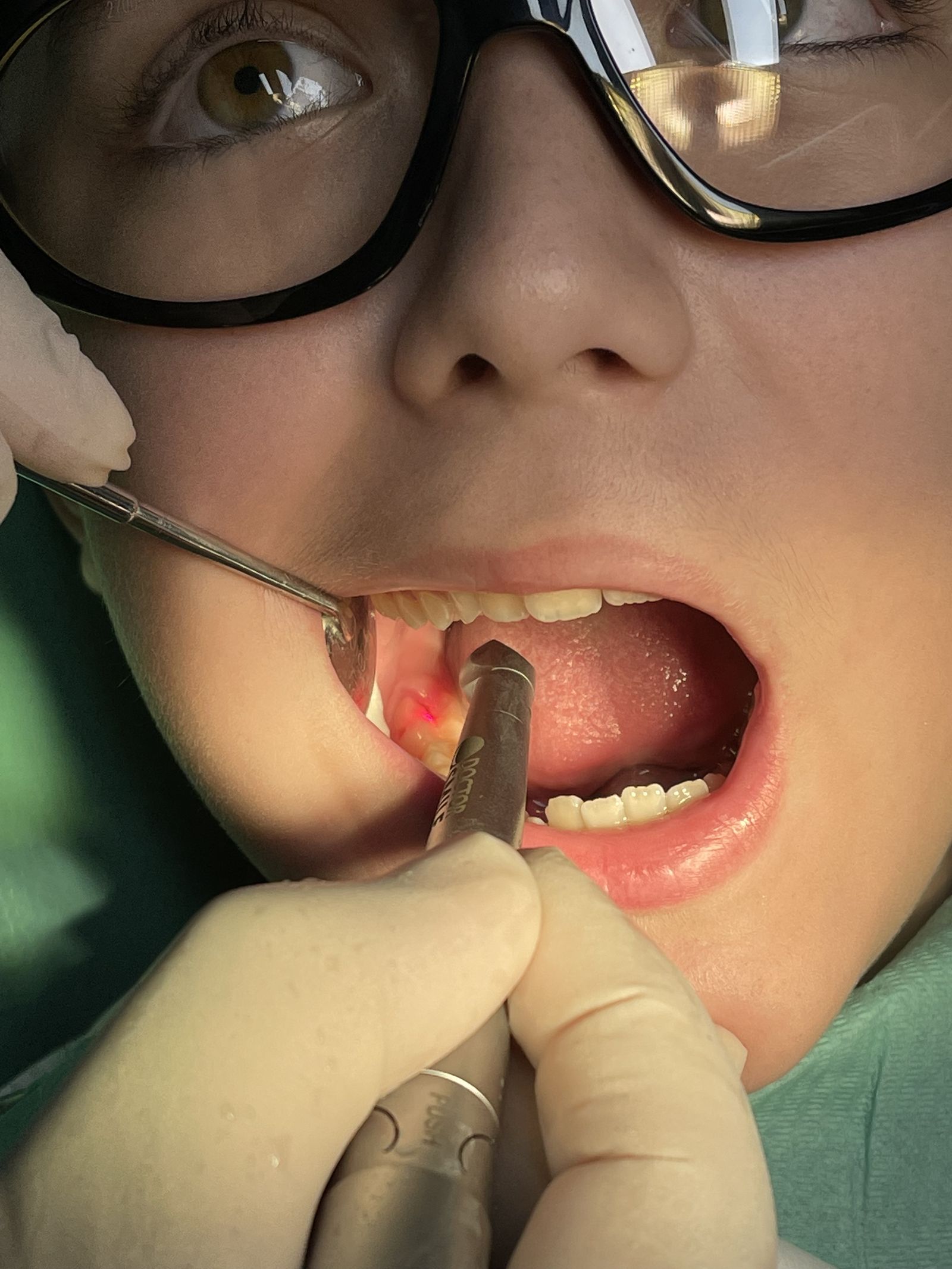
Pediatric dentistry
Dental treatment in children should begin as soon as possible; a good oral condition will promote correct development.
We recommend early check-ups, because the evolution of cavities in children is very rapid; sometimes the deterioration and subsequent pain in teeth that are difficult to recover happens because they are considered teeth about to be lost that carry no pathology.
- No needles or pain
- Fillings without anaesthesia
- Intraoral scanning
- Low-intensity radiographs
When do baby teeth have to fall out?

Eruption sequence · upper baby teeth
| Tooth | Eruption |
|---|---|
| Central incisor | 7 ½ months |
| Lateral incisor | 9 months |
| Canine | 18 months |
| 1st molar | 14 months |
| 2nd molar | 24 months |
Eruption sequence · lower baby teeth
| Tooth | Eruption |
|---|---|
| Central incisor | 6 months |
| Lateral incisor | 7 months |
| Canine | 16 months |
| 1st molar | 12 months |
| 2nd molar | 20 months |
Eruption sequence · upper permanent teeth
| Tooth | Eruption |
|---|---|
| Central incisor | 7-8 years |
| Lateral incisor | 8-9 years |
| Canine | 11-12 years |
| 1st premolar | 10-11 years |
| 2nd premolar | 10-12 years |
| 1st molar | 6-7 years |
| 2nd molar | 12-13 years |
| 3rd molar | 17-21 years |
Eruption sequence · lower permanent teeth
| Tooth | Eruption |
|---|---|
| Central incisor | 6-7 years |
| Lateral incisor | 7-8 years |
| Canine | 9-10 years |
| 1st premolar | 10-12 years |
| 2nd premolar | 11-12 years |
| 1st molar | 6-7 years |
| 2nd molar | 11-13 years |
| 3rd molar | 17-21 years |
Our criteria for working with children
The child's first visit to the dentist is the most important and generally the one they will remember for the rest of their life. The main objective is that they enjoy it and gladly return next time.
There is a period of adaptation and collaboration for the pediatric patient; we must all collaborate so that the experience is fruitful and natural. Promoting collaborative habits is good for our children and their health.
In the first visits we never perform complex or uncomfortable treatments for the child. Motivation, oral education, brushing techniques and care of their teeth are essential in these first moments of contact.
The collaboration of parents and family members is very important and essential for dental treatment in children. Never use the dentist to scare your child when he or she misbehaves at home.
Treatment begins when we have the child's trust and cooperation. This usually occurs at the second visit, but some children require more preliminary consultations.
When there is great destruction of the tooth, painful episodes occur that cause the visit to be carried out at a very advanced stage, having to cover the tooth not only with fillings and devitalization treatments but with STEEL CROWNS, to make these restorations more predictable over time. They are easy to place, do not generate trauma, and are very tolerable and appreciated by children for the comfort they provide.
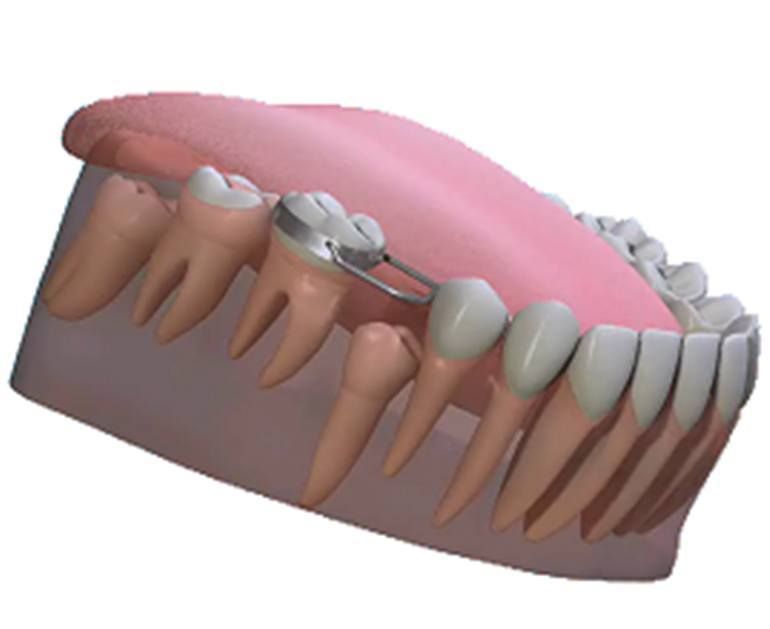
Space maintainers
During the tooth replacement phase, that is, during the period in which temporary or baby teeth are being replaced by permanent teeth, natural movements of the teeth may occur, leaving little space for the permanent teeth to emerge. This is because all teeth naturally tend to move forward towards the incisor area when they have space to do so (for example, the space left empty after the loss of a baby tooth is occupied by the tooth located behind it, which moves forward to occupy that space).
When a baby or temporary tooth is lost and the permanent tooth that replaces it erupts quickly, there is no time for a loss of space to occur. This situation is normal and occurs when the temporary or baby teeth fall out at the appropriate age, so that the permanent tooth erupts shortly afterwards.
On the other hand, if a temporary tooth is lost prematurely, either naturally or for other reasons (for example, extraction due to cavities), the permanent tooth will take a long time to erupt. It is precisely during this waiting period that space losses can occur, since the tooth located behind the space naturally moves forward to occupy it. When this occurs, the permanent tooth will not have enough room to erupt, so it will not be able to emerge or will do so in an incorrect position.
To prevent the teeth from moving forward to occupy spaces that do not correspond to them, space maintainers (preventive appliances) can be fitted, which preserve the space left by the lost baby tooth until the time of eruption of the permanent tooth that will replace it. When the permanent tooth begins to erupt, the space maintainer is removed.
They are characterized by:
- Maintaining the space.
- Being inactive.
- Allowing the growth and development of the jaws.
- Allowing tooth eruption.
- Preventing extrusion of the opposing tooth.
- Promoting chewing function.
For the child's mouth to develop and grow properly, the temporary (baby) teeth must be healthy.
We are your trusted dentist